
Companies need to focus

There are lots of rumors going around that Google is going to open up retail stores in time for the next holiday season. I don’t think they’ll succeed.

For some reason, there’s a desire these days for companies to expand outside their areas of expertise, whether it’s organically or through acquisitions. In the overwhelming majority of cases these expansion plans don’t work. Companies need to focus on their strengths.

Let’s look at some examples.

Google is a technology company
Google started out as a search engine, ventured into advertising, and then started creating all sorts of other technologies ranging from Gmail to a mobile operating system. In all of these cases, what Google does well is technology. They don’t do so hot on the support and marketing fronts. In fact, Google’s previous forays into retail selling of phones. The Nexus One, which was a great phone, was not promoted or marketed well, and anyone who tried to purchase a Nexus 4 before the holidays is well aware of how poorly they handled the demand for that product. I don’t see how they’ll be able to maintain a retail presence.

Apple is a hardware company
Apple may want to be claim their a vertically integrated hardware and software company, but in my mind they are a hardware company. What they do well is create hardware that is easy to use for the average consumer because of the user interface they place on the hardware. When they’ve tried to venture too far away from hardware into services and software, their efforts have not gone well. Just look at things like their Ping music service, iCloud, and most recently Apple Maps. Apple would be best served to focus their efforts on creating outstanding hardware and leave the software and services that go on top to someone else.

Microsoft is a software company
I find the rumors of Microsoft building their own smartphone entertaining. Quite honestly, I don’t think a Microsoft phone would even be as successful as the Surface tablet, which has gotten of to a very slow start. I understand that there is a certain allure for Microsoft in wanting to be like Apple, but the fact of the matter is that it’s not in Microsoft’s DNA. Similar to Apple, Microsoft would be better served to focus on the software side of things and leave the hardware up to their partners who know better.

BlackBerry is an enterprise company
What precipitated the demise of BlackBerry? Chasing the consumer. BlackBerry does not know how to service the consumer market – never has and never will. Even today, BlackBerry would be best served to focus on their enterprise strengths. They still need to build competitive hardware, but the hardware (and software) needs to be focused on serving the needs of their enterprise clients. By chasing the consumer market, BlackBerry alienated and lost their enterprise base and was never able to become relevant in the consumer space. In other words, they lost on both fronts, which they will be hard pressed to recover from, even with the release of BB10 and their new Z10 and Q10 handsets.

The moral of this story, identify what you’re good at and embrace it. Trying to expand to be all things to all people is a recipe for disaster that doesn’t work well for anyone, and it doesn’t matter if you’re in the technology business or outside of it.
In technology, nothing lasts forever

I was involved in an entertaining discussion with a group of individuals this week where someone stated that the battle for the internet is over, Facebook has won.

It made me laugh and think of an article that John Naughton wrote in The Guardian recently titled, “Why the Facebook and Apple empires are bound to fail.” It makes a bunch of great points.

“Nothing Lasts Forever”

Unfortunately, as in the real world, while companies are built to last forever, they don’t. Markets and technologies change, and the favorites of today eventually become forgotten tomorrow, only to be remembered through case studies and business school discussions. It’s hard for us to imagine a world where Microsoft, Apple, Facebook, Google, Intel and Cisco aren’t the dominant technology companies, but a time of decline will come for all of them.

“…Facebook’s latest attempt to become the AOL de nos jours…will fail for the same reason that AOL’s attempt to corral users within its walled garden failed: the wider internet is just too diverse, innovative and interesting.”

I don’t bet against the web. Naughton’s spot on when he says the internet is “too diverse, innovative and interesting.” There is only so much that Facebook can do to keep users captive on its site. There’s too much innovation and interesting content being created on the web for Facebook to keep up and stop users from leaving the comfort of their environment for greener pastures.

“…because Facebook looms so large in the public consciousness at the moment, it’s difficult to keep it in perspective.”

We tend to get so caught up in the moment that we lose historical perspective. Sure, people will say that it’s different this time. We heard that before the internet, telecom and real estate bubbles popped. There’s no such thing as different this time. Eventually, fundamentals (and reason) take over, allowing us to gain perspective and realize the errors in our previous ways of thinking.

“Although the eclipsing of Apple and Facebook is inevitable, the timing and causes of their eventual declines will differ….What will determine its [Apple’s] future is whether it can come up with new, market-creating products such as the iPod, iPhone and iPad.”

The hardware business is a brutally competitive business characterized by compressed product cycles and thin margins. Apple has managed to buck the trend temporarily, but it won’t last. They are one, maybe two, bad product decisions away from losing their status as a category defining company and becoming just another face in the crowd. Don’t think it’s possible, just take a look at Sony’s rise and subsequent fall as a consumer electronics giant.

“Facebook, on the other hand, makes nothing. It just provides an online service that, for the moment, people seem to value. But in order to make money out of those users and satisfy the denizens of Wall Street, it has to become ever more intrusive and manipulative  It’s condemned, in other words, to intrusive overstretch.”

If not already, Facebook will become a slave to its investors. Having a billion users means nothing if you’re not making money off of them. Facebook has been lucky thus far that its user base has tolerated so many of its over reaching privacy intrusions. At some point, Facebook’s need to satisfy its investors will force it to go too far, driving users away.

The moral or the story: history is doomed to repeat itself. When we’re engrossed in the moment, we lose perspective. It’s hard to see how the companies we hold in such high esteem today will fail. Unfortunately, nothing lasts forever, and the cyclical nature of technology only reinforces that tired cliché.

Hi, my name’s Gregg, and I’m a Google Reader addict

How do I know I have a problem?

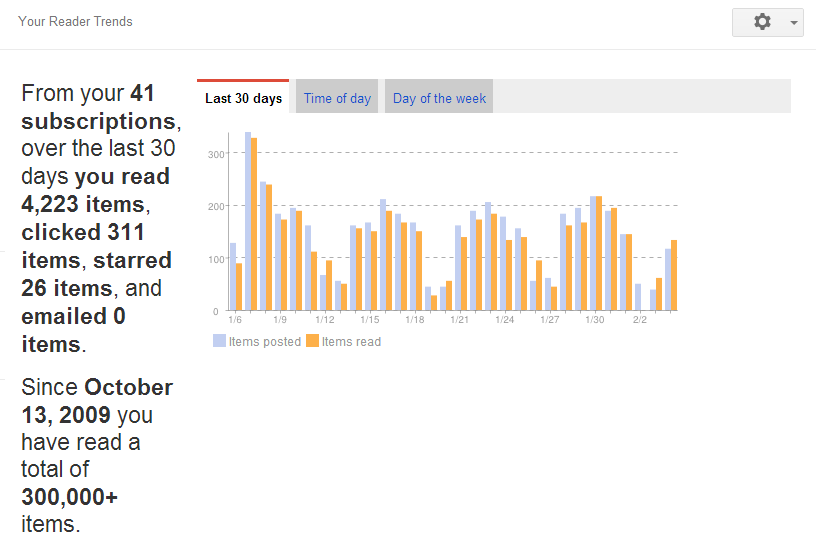
When I opened Google Reader this evening, it said that “Since October 15, 2009 you have read a total of 300,000+ items.” 300,000!!!!!!

I was introduced to Google Reader about five years ago. It’s what’s known as a feed reader. It allows you to subscribe to RSS feeds from websites and blogs so that every time a website publishes new content, it shows up in your feed reader. It’s a way more efficient way to get new content from websites since it is delivered to you instead of you having to check the website regularly. If you set it up properly, it’s like having your own personal newspaper where you get only the news that matters to you.

However, you need to be careful, because it can become an addiction. Once you realize how many websites have RSS feeds, you feel the urge to start subscribing to all of them. At my peak, I was subscribed to over 100 feeds and was getting up to 500 new articles, per day!

Now, Google Reader does have some tools to help you sift through articles quickly, like using the ‘j’ key or the space bar to quickly skip articles, or just marking certain feeds, or all of your articles, as read. But even just skimming through 500 articles takes a lot of time, and it’s stressful. It’s like working at the post office, no matter how many articles you clear, you know that more are on the way. Plus, I never liked marking lots of articles read because it made me feel like I would miss something.

After a while, I recognized I had a problem and was spending too much time with Google Reader, I decided it was time to cut back. I started culling unnecessary feeds and got my daily article count down to about 350 a couple of years ago. Then at the beginning of 2012, I felt more cuts were needed and got my daily count down to 200, which I’ve found is about the upper limit of what I can manage on a daily basis. If the number gets too far about 200, I find it takes too much time and effort to sort through.

Here is a snapshot of my reading trends from a few days ago. It shows that the average article count is about 200, although there are days where it can spike to 300. These usually indicate a special event, in this case the Consumer Electronics Show. I guess that’s the price of following tech blogs like Gizmodo, Mashable and GigaOM.

Google Reader Trends

It felt good over the last year to get my addiction under control, but I still have more to do. I’d like to cut more this year and get the daily article count to between 125 and 150.

It’s a balance. While I like reading lots of different feeds, there comes a time when you have to cut down to the ones that really matter, and I’ve reached that point.

In the end, I wonder if my experience follows most Google Reader users. Sign up, subscribe to a few feeds, discover how awesome it is, then subscribe to way too many feeds, and finally realize how overwhelming it is and start the gradual process of cutting back.

Either way, it feels good to manage the addiction. I’m just hoping I don’t fall off the wagon….

Don’t bet against the web

There is concern these days that the web is under attack as companies like Google, Apple, Facebook and Twitter wage platform wars in order to control and monetize their users. These companies have amassed large user bases, and the longer they can keep their users on their platforms and within their “walled gardens”, the more money they can potentially make off of them through services and advertisements. This causes these companies to curate web content for their users, bias search results toward their web properties and offerings, and take ever increasing liberties with their users personal information and trust. While they may not be trying to replace the web, they are trying to replicate it with a network their users will never have to leave.

I do not share this concern over the web because I’ve seen this game played out before.

Twenty years ago, online companies Compuserve and AOL tried to play the same game. Both companies amassed large user bases. They provided a gateway for people to access their version of the web, which was a moderated and curated version of content supplied by both companies and individuals.

I was a member of AOL back in the days before the web browser. At the time, it was the best way to access online content. You could participate in chat forums and user groups. You could read magazines such as Sports Illustrated and Consumer Reports. Companies advertised and created storefronts where you could buy stuff, not much different than Facebook Fan Pages of today.

With the introduction of the web browser, people discovered there was a much richer experience on the web outside of the walled gardens of AOL and Compuserve. As people left for the freedom of the open web, AOL and Compuserve’s user bases dwindled. AOL and Compuserve tried to maintain their user base by replicating their curated experience on the web, but this failed, too. I left AOL back in the late nineties, and I can’t remember ever accessing their site on the web.

The moral of the story is that you don’t bet against the web. While Facebook, Apple and Google may want to keep (or trap) their users within their walled gardens, it is only temporary. Eventually, a service or company that provides more freedom and unfiltered access to information from the web will displace these companies. It’s only a matter of time.

Trends always move in cycles. Whether it’s fashion, hairstyles or technology, there will be fads that come and go, only to return later. Trying to trap users on your platform is one of those fads. It passed once, and it will pass again.

So while I won’t bet against the web, I will bet that this fad will pass. And it’s a bet that you can take to the bank.

Tablets are luxury items

I resisted the tablet craze for the last two years. I just couldn’t see how they fit into my digital lifestyle. Most of what a tablet was good for I could do on my phone (especially my large screen Galaxy Nexus), and it couldn’t replace my laptop. A tablet just seemed like a product looking for a solution. I just couldn’t understand why people were so excited over them, even to the point of calling them “magical”.

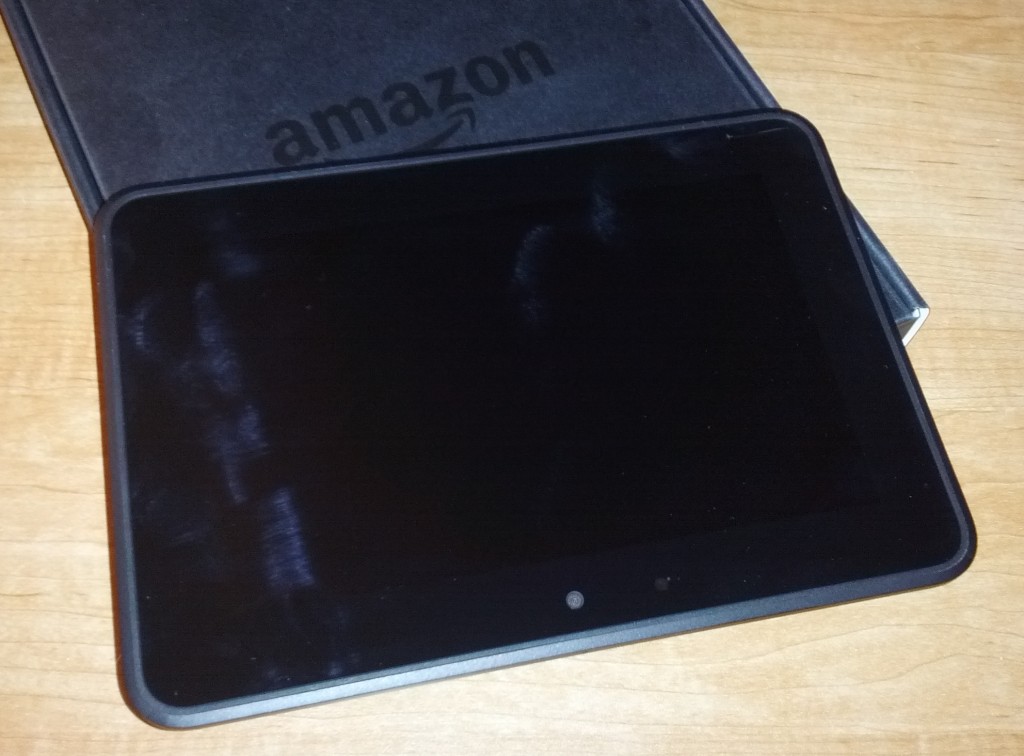
With the introduction of the Kindle Fire HD and Nexus 7 last year, the prices of good tablets fell to under $200, so I figured it was time to give them a try. I picked up one of each over the holidays.

Kindle Fire HD

After a month with the devices, my position hasn’t changed. I’m struggling to find a place where these fit into my daily routine. I’ve come to the conclusion that tablets aren’t a necessity, and they aren’t even a little magical, they are a luxury.

Over the last month, here is how my family and I have used the device:

  1. Casual browsing. Every now and then Lisa and I will pick up the Nexus 7 and browse a couple of websites. It doesn’t happen regularly, but more out of convenience when we’re too lazy to move off the couch to the computer.
  2. Gaming. My youngest, age 10, enjoys playing Temple Run (and more recently Temple Run 2) on the Nexus 7. In other words, it’s a miniature Xbox.
  3. Watching video. My other daughters have used the Nexus 7 for watching Netflix when we first got the tablet, but that novelty has worn off. They’ve gone back to catching up on their favorite shows on our 55-inch HDTV’s.
  4. Reading books. I’ve picked up a couple of free eBooks for the Kindle and plan to buy a couple soon. It’s convenient but not necessary. I could have used my phone or bought the actual books, but since I have the device, I might as well use it.

If you’re thinking about a tablet, I’d point you to an article that I wrote almost exactly one year ago on the miniListings blog. It’s amazing that even a year later, the technology still hasn’t evolved to the point where the tablet is ready to replace the laptop. Once it gets there, then my position might change.

Why I’m not an Apple fan

It will come as no shock to my family and those who know me that I’m not a fan of Apple. It’s not that I don’t like their products. They’re great. Apple products are the best designed products on the market. I dislike them because of their business practices.

I don’t like that Apple insists on owning the end-to-end experience. While they’ve created the best hardware, their software can leave a lot to be desired. Sure they make some great applications. But for every one good one, there’s an Apple Maps. And don’t even get me started on iTunes.They think they can create the best software to go with the hardware, and in the process, they lock out potentially great alternatives. It handicaps how good the Apple experience could be.

I don’t like that they try to lock you in, for life. Once you pick up an Apple product, you get sucked into their environment. You can resist, but the alternatives are always way more painful than what Apple provides. In the end, it makes it difficult to ever switch away from Apple’s products, locking you in. If Apple should fall behind or muff a new product design, you are stuck with their poor choices.

I don’t like that they treat me like a child. Why does Apple always feel the need to protect me from myself? They ruthlessly censor curate the app store to keep out what they feel are unwanted apps. For years they prevented multi-tasking for fear I would run too many apps at once and kill battery life. They make all the hardware choices and limit the ability for me to customize the product. It keeps me from being able to tinker and experiment, much like the rules we give our kids to protect them from hurting themselves.

I don’t like that Apple has an arrogant attitude. Why does Apple insist on using its own connector when every other vendor uses micro-USB, allowing me to mix and match chargers in my house? When the iPhone gets poor reception, why is the answer I’m holding it wrong? Why does Apple insist on using a different SIM card size, the nano SIM, than every other phone? I would expect an industry leader like Apple to have some amount of arrogance, but they’ve taken it to a whole new level.

I don’t like that Apple charges a premium for their devices. Whether it’s a laptop or a phone, Apple charges almost 2x for an equivalent competing product. Case in point, my daughter’s iPhone 5 was twice the cost of my son’s Nexus 4, which is every bit as good as the iPhone if not better. I had a similar experience buying a laptop for my daughter two years ago. The Windows laptop I bought was equivalent to the Apple device in every way except styling and price, which was 50% less. To this day, I’m still amazed at the marketing job that Apple has done and how it is able to continue to charge the “Apple tax” for its products.

For the longest time, I thought I was the only one who felt this way. Lately, though, I’ve noticed more people are starting to question Apple’s practices. Others are even considering switching away, which does not bode well for Apple’s future.

If Apple wants to grow and eat into Android’s popularity, they will have to open up and change their business practices. Until they do, I’m staying away and sticking with my Android and Windows based devices.

The Great Beard Experiment of 2012-2013

I’ve never had a beard or mustache, but I usually let my facial hair grow out a bit over the holidays. I usually start a week or so before Christmas and shave it off after New Year’s. There’s no rhyme or reason as to why, I guess it’s just a way of mixing things up a bit.

This year, I started a bit earlier during the second week of December and still have it. I’ve kept up with maintenance and trimming, but this is by far the longest I’ve let my facial hair grow.

I thought it would fun to post a pic before it comes off, which is happening this weekend. I’ve gotten over the itchies and all the other nonsense of having a beard, but it’s not for me. Plus, keeping up with the trimming and maintenance is nearly as much work as shaving everyday, so I don’t get the point of keeping it.

Fear the Beard!So what do you think, should it stay or should it go?

Technology shouldn’t control you, you should control it

Samsung Galaxy NexusLast year, after being interrupted by yet another email notification alert on my phone, I decided it was time to take control of technology. I was getting interrupted and distracted “feeding” my smartphone every time it made a sound. Like Pavlov’s dog, I had been conditioned to reach for my phone every time the email notification alert sounded, even though I knew that the overwhelming majority of messages were not important or critical. I took the simple step of turning off notifications on my phone, which had a huge positive impact on my productivity.

Soon after, I discovered another hidden productivity killer, the Google Mail Checker extension for Chrome which shows how many unread email messages you have. It’s was a distraction for me, and as the number of unread messages grows, it pressured me into checking my mail. Maybe it’s a useful tool for some, but it was a tool that was using me instead of the other way around. Disabling this extension not only further improved my productivity level and focus but also reduced my stress level.

Basically, I had a problem, and I found out I wasn’t alone. Numerous people I spoke to over the last year came to the same realization and started reducing or eliminating their technology interruptions, too. Then, I saw a number of articles toward the end of last year from people within the tech community questioning the pervasive nature of technology and the addictive nature of our smartphones.

The first article that hit my reader was this one by Brad Feld titled “My Smart Phone Is No Longer Working for Me”. This inspired a post by Kevin Tofel at GigaOM titled “Is it time to wean yourself off of the smartphone?”. Yet another article by Om Malik appeared earlier this month entitled “Realtime & the off switch”. All three articles share the common theme of how taking control of technology, or your smart phone in this case, leads to a more balanced and focused mind, less stress, and greater peace. If you’re feeling overwhelmed by technology, I’d highly recommend reviewing all three articles.

The bottom line is this, technology isn’t going away, and we shouldn’t hide from it. But that doesn’t mean we should let it distract us, ruin our productivity or punish ourselves for using it. If you’re still letting technology control you, it’s time you start controlling it. Here’s some simple steps you can take to start down the rehab path:

  • Turn off as many notification alerts as possible on your phone. I’ve turned off everything except for calendar reminders (so I don’t miss meetings) and text messages (which I use for urgent messaging).
  • Turn off computer notifications, especially for email. Check email when you decide to, not when it tells you it wants to be fed.
  • When engaging with people either one-on-one or in a group, put your phone away. Stay focused in the moment. Not only will you get more out of the interaction, it also shows you respect your time with others.
  • Spend time away from your phone or computer everyday. Watch a movie or read a book. Embrace and cherish your quiet time.

I’ve used these over the past year with great success and plan to continue to use them in the future. I’m also on the lookout for more ways to reduce distractions to become even more productive and focused this year. Ideas are welcome.

Can you work from home?

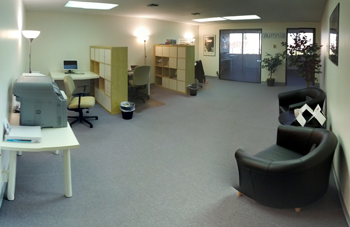
The Aumnia OfficeTelecommuting and remote working options continue to grow in popularity. It begs the question, can you be effective working from home?

My answer – it depends.

I spent the first 14 years of my career working in an office. I never worked from home and was opposed to having people in my group do it. Back in that time (prior to 2005), the lack of broadband connectivity and communication tools made it difficult for people to get their jobs done when they weren’t in the office. In my mind, working from home wasn’t an option.

When I started my own company in 2006, working in an office was a luxury we couldn’t afford. I was forced to work from home to get things started.

At first, working from home felt like liberation. There was no time lost commuting, getting lunch was a simple walk to the kitchen, and I was never late for dinner. On the other hand, the distractions were numerous. Home projects that waited until after work or the weekend called for immediate attention, family members interrupted with non-work related questions, and household noise (especially from the kids during the summer) made concentrating difficult.

It took me the better part of two years to figure out how to be productive working from home. Here are some lessons I learned:

  • Establish a work schedule and stick to it. Don’t fall into the trap of working strange hours. A regular work schedule helps with the discipline of when you are “at work” and when you are “at home”.
  • Let family members know your work schedule. Set times with your family when you are “at work” and when you are “at home”. I’m aware of someone who went as far as to close his door when he was working and have family members call him on the phone during “work hours” to talk. I’m not suggesting it needs to be this radical, but family members need to respect work time vs home time.
  • Dedicate a place in the house for working. If you plan to work at the kitchen table where you eat, it won’t work. Pick a room, or even a desk, that is only used for work. A dedicated work space will put (and help keep) you in a working frame of mind.
  • Separate home computer from work computer. There are too many distractions on your home computer that can interfere with work – think games, browser favorites, being logged into social networking sites, chat programs, etc. A dedicated work computer reinforces the notion that you’re working when you’re on it.
  • Have a reliable, broadband internet connection. I would think that no further explanation is needed here.
  • Dress for work. Just because you’re working from home doesn’t mean staying in your underwear all day. Dress as if you were going to the office – it’s a psychological thing.

Unfortunately, I’ve learned that these work from home tips aren’t enough me. I started working in an office again last year, and my productivity has risen – both at work and at home.

While I can make telecommuting work, it’s not the best situation for me. I am most productive when I can physically separate work from home. I know other people have figured out how to be more productive when working from home, which is why I say “it depends” when someone asks me the question. It’s a decision you have to make based on your situation and work habits.

Maybe someday I’ll take another crack at working from home, but for now I’m going to stick with what’s working.

Facebook and the ‘Nightclub Effect’

I’ve been surprised, and amazed, at the rise of the social web over the past couple of years. It’s not the social part that surprises me. It’s the hype surrounding social networking sites that caught me off guard.

The internet has been and will always be a social place. Its social roots can be traced to the bulletin board systems of the mid/late eighties, newsgroups of the early nineties, AOL/Geocities of the late nineties, message boards/blogs from the early 2000’s, MySpace during the mid-2000’s, and most recently Facebook. The trend is fairly obvious, there has always has been a social aspect to the web, and it is always changing and evolving with new players replacing the old.

It’s something I like to call the ‘Nightclub Effect’. New bars open up all the time. If a new bar hits on the right theme and/or attracts the right people, it rises quickly in popularity. When the popularity rises, more people flock to the nightclub, and one of two things happens:

  1. The nightclub becomes crowded, and the “right people” move on to the next new bar in search of a place where they can socialize without bumping into people that they don’t want to see in a social setting, such as their parents who have discovered their cool hangout spot, OR
  2. The nightclub tries to capitalize on its success by trying to appeal to a broader audience. In doing so, they dilute the original experience that made the nightclub the hip place to be.

Both cases have one detrimental result – they drive customers away in search of a more private place to socialize with friends that has a “hipper” atmosphere. The result is that the cool place is no longer considered the place to be. Sometimes the demise can be sudden, sometimes it can take a long period of time.

Social media sites on the web follow the same arc, and I believe Facebook, has reached its peak and begun its decline into mediocrity. New platforms such as Instagram, Pinterest and Snapchat are eating away at Facebook’s popularity. I see examples around me based upon how my family uses Facebook. We went through the following phases in using it:

  • Discovery: someone tells you about Facebook. You sign up, see people you know, and start connecting with old friends. You don’t know how or why you waited so long to get an account.
  • Engagement: after getting setup, you feel like you need to be on Facebook all the time or you might miss something. You get anxious waiting for people to respond to your posts and enjoy reading about and commenting on what others are doing. You are oblivious to how much time you are spending in Facebook.
  • Realization: you suddenly realize that you are spending way too much time using, posting, replying and stalking people on the site. You begin to slowly reduce your  usage of the site.
  • Disappointment: sometimes this occurs before or at the same time as realization, but you are disappointed by the lack of privacy on the site. You regularly bump into people you wish weren’t on the network. It could be old high school friends, ex-significant others, neighbors, or judgmental relatives. You start pulling back from posting and begin looking for another place to gather with your friends where your activity won’t be seen by so many people
  • Boredom: checking Facebook becomes a necessary evil just to stay in touch with what’s happening, but you don’t get any enjoyment from it anymore. You spend less and less time on Facebook and more of your time on other sites.

In fact, most members of my family have already hit or are close to the boredom phase. I’ve seen my teenage kids move away from Facebook to Instagram and Snapchat. I’m sure they’re playing around with other social networks as I write. And I don’t think my family is an outlier, I see this as a trend that began 12-18 months ago.

Does this mean the social web is doomed to collapse? Of course not. As I wrote at the start, the web is social at its heart. The social aspect of the web is alive and well, and always will be. In fact, I expect the web to only get more social moving forward. What I do expect to change is how people engage, and I doubt it will be controlled by today’s most popular sites.

So while the social web is fine, the social networking site owners are not. They are in a perpetual game of reinventing themselves, trying new features and testing new formulas in an attempt to maintain a shine that keeps existing users happy while attracting new ones. I don’t think it is a game that can be won over the long haul given the nature of competition and the low cost of starting alternative networks. The fickle nature and delicate psychology of users doesn’t help either

Today’s social networking darlings will succumb to the nightclub effect just like bars and restaurants do in the real world. And just as new bars and restaurants spring up to replace the old, new social networking sites will rise to do the same.