Category Archives: Business and Technology

Analyzing the cost of the triple play

As a fun exercise using the magic of Quicken, I created a graph of my triple play cost (phone+cable+internet) since 1997. Even though the data was collected in monthly intervals, I averaged the cost annually to smooth out fluctuations, which were especially prevalent in the phone data pre-2008 when long distance phone calls were still being charged by the minute.
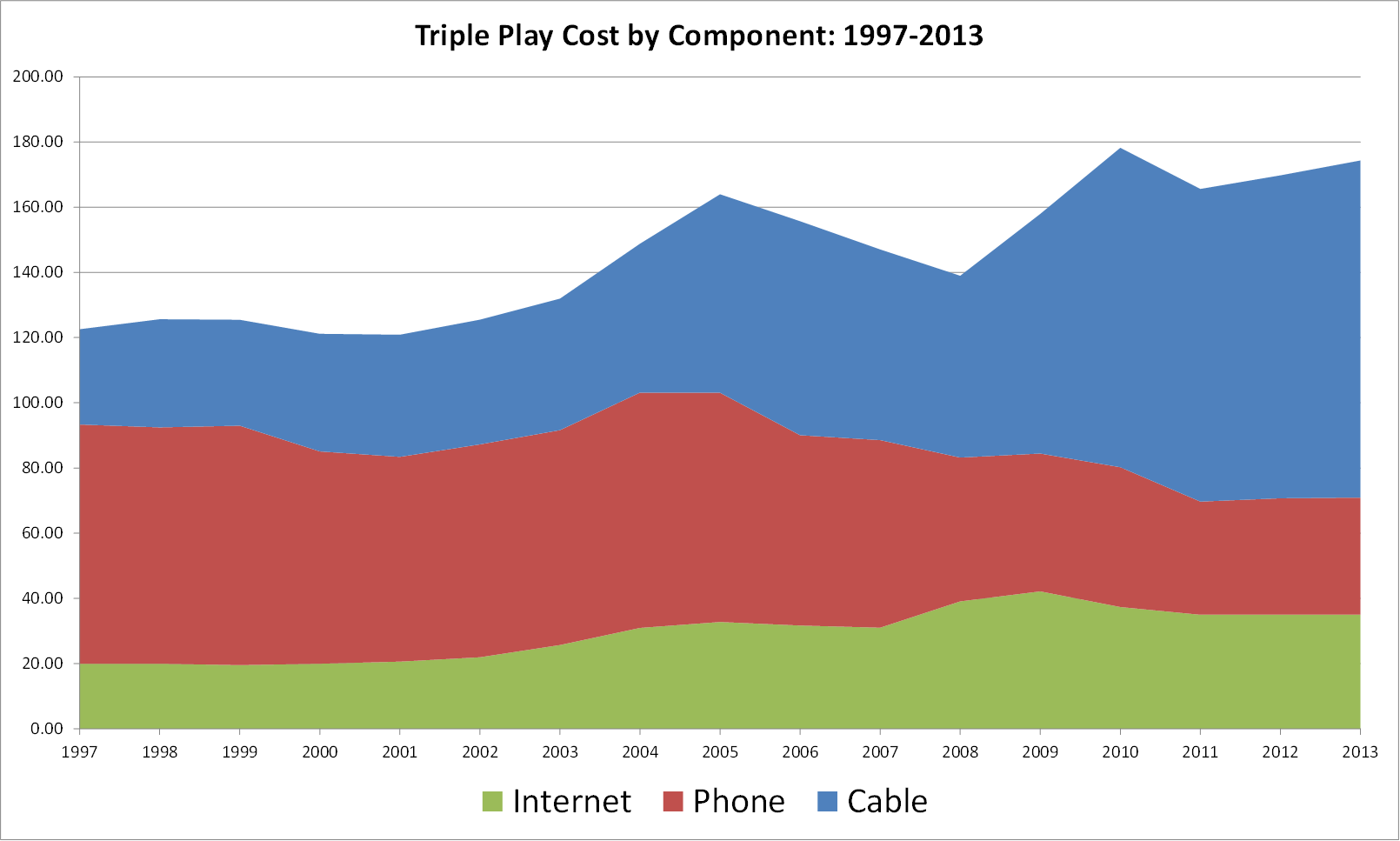
Triple Play Cost by Component: 1997 - 2013

Analyzing the triple play cost

What the data shows us is not a surprise, and I suspect that is indicative of what is happening in most households. The overall cost of the triple play has increased ~50% over the last 15 years from $120/month to $175/month. However, it’s not the total cost of the triple play that’s noteworthy. It’s trends in the individual components that are interesting. Namely,

  1. The value of landline phone service is declining
    The cost of phone service has been cut in half over the last 15 years and will continue to drop, eventually reaching zero. I’m not surprised given that I rarely use my landline. I’m paying $30/month to rent a phone number to give to telemarketers. When I look at my children, who have grown up with a cellphone as their primary means of communication, I doubt any of them will ever pay for landline service in their lifetime, which portends the end of landline service as we know it in the not too distant future.
  2. Advances in internet service have far outpaced the cost
    Once could argue that paying $20/month for unreliable 56kbps internet service that was metered by the hour was ridiculously overpriced, but it is the baseline. Compare that to paying $35/month for a pipe that is reliable, is always on and delivers 15Gbps, and it’s clear that internet service is a bargain these days, a HUGE one! Stated more bluntly, the service is infinitely more reliable and over 250,000 times faster. If speed and cost were directly proportional, I should be paying over $5,000,000/month for internet service today. As it stands, internet costs haven’t even doubled over the last 15 years.
  3. Cable’s cost increase doesn’t match it’s value proposition
    While the number of channels I receive has increased from 70 to over 600, the number of channels I watch has changed from 10 to about 15. I’m paying over 3x the amount for a service whose value proposition hasn’t changed significantly. If you were to cut off my cable service tomorrow, I might miss watching sports and a few Seinfeld reruns, but other than that, I’m not sure I’d notice. On other hand, if you were to turn off my internet service, I’d be reaching for my checkbook.

What the analysis tells us

  • Cord-cutting is not a fad
    Disputes over content distribution, like the one that happened between Time-Warner and CBS are becoming more and more common and are continuing to drive up the cost of the cable. People are tired of being held hostage to the cable companies and content providers and aren’t going to tolerate it. The result will be more cord-cutting. You can get by without cable today by using an over the air antenna and internet services like Netflix and Amazon Instant Video, but it’s not quite the same. However, these solutions are improving rapidly, and it’s only a matter of time before cord-cutting catches up to and surpasses the content provided by cable.
  • The cable business is ripe for disruption
    Bundling of content is not a sustainable business model. I don’t want to pay for a service where I don’t use 90% of what is being supplied. If the cable companies do not recognize that their value is in the delivery network and not the bundling of content, they will be marginalized by more innovative and progressive thinking companies like Netflix, Amazon, HBO and YouTube (Google). Cable needs to move to a different model, such as a la carte or on-demand programming, sooner rather than later.

Where we’re headed

I’ve believed for over 10 years that content programming would migrate to an on-demand model. I thought for sure that it would’ve happened by now, but the entrenched players have been slow to move and have used government lobbying to slow down and impede competitive services. History has shown that these tactics only delay the inevitable. The companies that refuse to change are eventually replaced by those that embrace the new business models.

Bottom line, the cable companies and content providers need to start allowing us to choose what we want, when we want it, and only charge us for what we use. Otherwise, we’re going to start letting companies into our living rooms that will.


Companies are not rational entities

During my time of despair after Google decided to kill Reader, one of my favorite bloggers, Michael Mace, wrote a great article titled “Google Logic: Why Google Does the Things it Does.” As with most of Mace’s articles, it’s a long read, but very well written, insightful, and thought-provoking.

In the article, Mace theorizes on why Google does a lot of things that it does, like killing products that people love (e.g. Reader), buying Motorola, and even things like the evolution of Google Docs. He does a great job of showing how the corporate culture and actions & egos of the founders influence how and why Google does what it does. He also points out what he sees as Google vulnerabilities, why their competitors (Apple, Microsoft, Facebook, and others) succeed against them, and how those same competitors can continue to do so going forward.

The most important point he makes in the article is not about Google. Near the beginning of the article, he states:

…it’s a mistake to assume there’s a logical reason for everything a company does. Sometimes managers act out of fear or ignorance or just plain stupidity, and trying to retrofit logic onto their actions is as pointless as a primitive shaman using goat entrails to explain a volcano.

In my opinion, what he’s trying to say is that companies are not rational entities.

For whatever reason, we on the outside want to believe that a company is led by rational decision makers who use nothing but data and quantitative factors in their decision-making process. Unfortunately, having personally been involved in key decisions at a large company, most are driven more by ego, emotion, politics and inertia than quantitative factors. That’s why we are regularly frustrated when Google kills are favorite product, Apple fails to announce an updated Apple TV or smartwatch, HP does nothing with WebOS, Microsoft flubs Windows 8, and so on.

To put it another way, companies are not designed to make intelligent rational decisions. Their job is to satisfy stakeholders (employees, customers, investors) and to keep the company running smoothly, which sometimes involves stroking the egos of key employees, reacting emotionally to competitive pressures, or playing corporate and industry politics. It’s why I believe Mace’s article is spot-on and a must read for anyone who wants to understand corporate dynamics. He breaks down the qualitative factors that are most likely playing into Google’s decision making process and strategy. It will help you understand why companies are not rational entities.

Am I the only one not excited about Google Glass?

There’s a lot of buzz these days about “wearable” technology. From things like Google Glass to smartwatches, they seem to be popping up everywhere. While wearables may be the future of technology, I’m not all that excited about them.

As tech pundit Robert Scoble, a Google Glass fanatic, has pointed out, there are a lot of conveniences a wearable offers. He talks about how easy it would be to buy things or get directions to a local coffee shop by just saying it. It all sounds great, but I think he and the other proponents are neglecting to point how selfish these devices are and what the cost is to those around them.

The ability of these devices to capture photos and videos without one’s knowledge or consent seems to be a really big issue that is not being addressed. With past technologies, society has implemented norms and laws regarding the capture and transmission on one’s recorded likeness or voice. For example, I’m not legally permitted to record a phone conversation without the other party’s consent. Even photos and videos are subject to privacy laws surrounding broadcast and retransmission.

To put it bluntly, I’m not comfortable with the proliferation of these devices before the moral, ethical and legal ramifications have been discussed, which it seems as though everyone wants to sweep under the rug.  As another example, take a look at this article by Gizmodo author Leslie Horn who was at the Galaxy Gear smartwatch launch. She was able to take video and snap photos of someone without them noticing. Not only is it creepy, as she points out, but it seems invasive. At least if she was pointing her phone at them, they’d have some reason to believe that she was capturing my actions. With the watch, it can be done very discreetly.

On top of the privacy concerns, there’s also the whole government/NSA/PRISM monitoring debate. I’ve already written my piece on these programs, and these devices certainly aren’t going to allay my concerns about them. In fact, it only further fuels my concern as we head deeper into Brave New World territory where the government doesn’t have to develop the tools to monitor us, we’re happy to give up our freedoms away and do it to ourselves. I can already see the justification for future privacy invasion – “it’s not different than what people are already doing with Google Glass.” How convenient.

I guess my point is that just because we can doesn’t mean we should. Yes, a wearable computing device does have its uses. I can clearly see how it could be helpful in surgical applications, educational settings, or other industrial applications. However, that doesn’t mean that we should use it in social applications. I can easily see why most bars, nightclubs, and other social gathering areas would want to ban these devices. It would certainly curtail the mentality of “what happens in Vegas, stays in Vegas”.

I fear that we continue to create technologies that satisfy our own personal indulgences and make our lives more convenient at the expense of future generations. It makes me wonder whether our generation will be remembered as the one that created technology to improve our lives or to strip us of our humanity.

My first Kickstarter funded project – Pressy

I’m not a big fan of Kickstarter. I’m not sure why, but it’s probably a matter of trust. There’s something about pledging money to strangers that doesn’t feel quite right. However, when I saw this post on GigaOM for Pressy, the Almighty Android Button, I couldn’t resist.

Pressy

According to the Kickstarter page

Pressy brings back simplicity to your phone. Perform your favorite and most common actions with a simple, intuitive physical button.

There was something about the simplicity, yet power, of the product that made me decide to go for it. It also helped that it looked as though it was selling pretty fast, and I’ve heard that popular Kickstarter projects can sell out, so I decided to jump in. At $17 for a button that plugs in to your headphone jack, it’s a pretty low risk gamble to take if it doesn’t come to fruition, or if doesn’t work great.

The possibilities for the button are seemingly endless. It comes with three actions pre-programmed: a single click to toggle your flashlight, one long click to toggle silent mode, and a double click to take a photo. With the included app, you can change the pre-programmed functions or assign your own which sounds pretty cool.

Pressy is slated to be available in four months or so. As of the date of this post, they’ve already raised $332,730 that’s way past their stated goal of $45,000. I’m looking forward to trying it out.

Charting Oil and Gasoline prices since 1991

I’ve always been a bit curious about the correlation between oil and gasoline prices. In other words, when oil goes up or down, how much and when do gasoline prices change.

Through an internet search, I was able to collect the monthly prices of both oil and gas from the U.S. Energy Information Administration. They have publicly available data on the price of gas that goes back to 1991, and for oil back to 1974. Below is the graph I created that shows how the price of oil (in red) against the price of gas (in blue) since 1991.

Oil prices vs Gasoline prices, February 1991 - June 2013

As you would expect, the prices track each other very closely. I did notice a few interesting items from the data:

  1. It’s not uncommon for it to take up to 2 months for changes in the price of oil to show up at the pump. In other words, changes in the price of oil don’t normally show up immediately in the price of gasoline.
  2. Over the 20 years of data, the price of oil has increased approximately 5x (from $20 to $100) whereas the price of gasoline has only increased around 3.5x (from $1.10 to $3.63). I’m not sure why there isn’t a one-to-one correlation, but I’m not complaining. If the correlation was exact, we should be paying closer to $5.50 per gallon.
  3. Speculation in the gasoline market never seems to last long. There are a few points where there was spike in gas prices that did not correspond to a spike in oil prices, but these spikes did not last for an extended period of time (examples are May 2001 and May 2007 time periods).

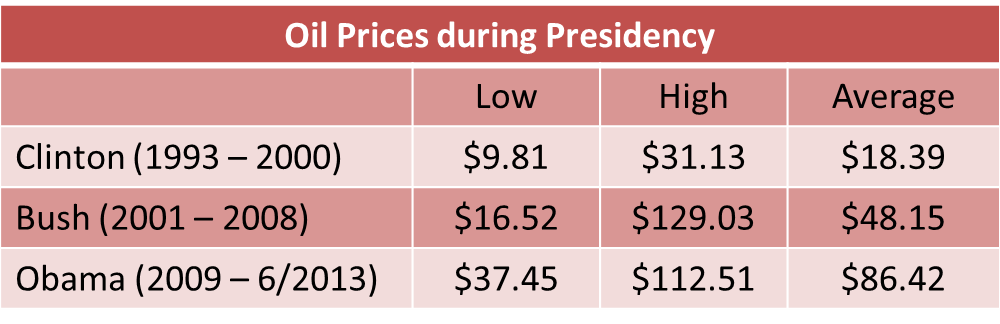
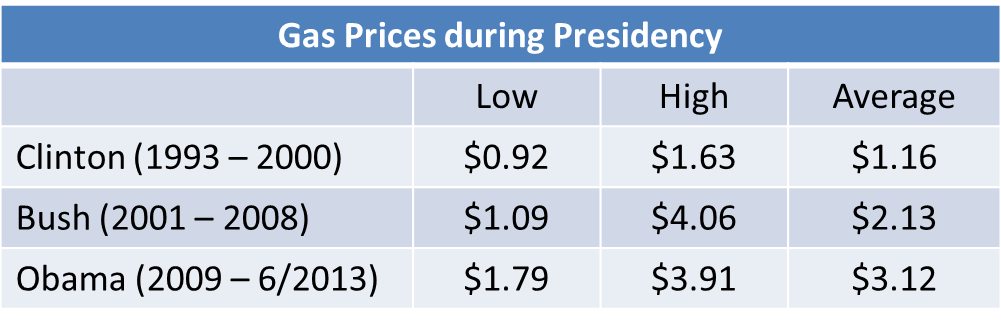
My second fascination has been understanding how much influence the president has on the price of oil. The media would lead you to believe that the president has significant influence over oil prices. They also paint the Democratic Party as an enemy of the oil industry which puts downward pressure on prices, whereas the Republican Party is cozy with the oil industry and supports higher prices.

To check this hypothesis, I looked at the prices of oil and gas during the last three administrations – Clinton, Bush, and Obama. I identified the low, high, and average price of both oil and gasoline during their presidencies. Obviously, the data for Obama is not complete and only covers up to June 2013. Let’s take a peek at the data.

Oil Prices during Presidency

Gas Prices during Presidency

While there are fluctuations in prices during a president’s term, the overall trend appears to be governed by forces of supply, demand, and inflation, with occasional speculative events mixed in. My conclusion from the data: the president does not have much influence or control over the price of oil and gasoline despite what the media would lead us to believe.

What’s with all the accelerator programs?

Over the last two weeks, I’ve read about two more accelerator programs that have started – one by Coca-Cola and the R/GA Connected Devices Accelerator. It seems like every week there’s a new startup accelerator.

The startup accelerator is a model for getting new companies off the ground by providing a small amount of capital, access to mentors, and working space in exchange for equity. Y Combinator started the movement and has been followed by numerous others including TechStars, LaunchPad LA, Start Engine, Amplify, Betaspring, Excelrate Labs, and 500 Startups to name a few. They’ve become so numerous (and popular) that a website called Seed-DB was created to track them. By their current count, there were 171 programs worldwide that have seeded 2,891 companies with $2.6B in funding and have thus far achieved 155 exits worth $1.3B.

The falling costs of technology such as servers, storage and bandwidth have made it easier than ever to start companies, which explains the proliferation of accelerators. It’s possible to seed a lot of companies with a small amount of money. Providing a group with $50,000 to $100,000 enables them to make a lot of progress in developing a product, in some cases even getting it to market.

While this appears to be a great boon for the startup community, I worry that it could have a negative effect. Just like a proliferation of franchises in a professional sports league has the effect of diluting the product by spreading talent across a larger number of teams, I’m beginning to wonder if the proliferation of startups is diluting the quality of companies and products by spreading quality talent across an ever widening pool of companies.

From my first hand experience, starting a company isn’t glamorous, it’s hard, really hard. It takes a lot of skills, not just a few kids and a couple of computers. It requires engineers to build a product, staff to handle finance and accounting issues, marketing skills to position and promote the business and product, people capable of building a team through hiring and leadership, and a sales group that will generate revenue for the company.

I don’t believe that there are enough qualified people available to build the quantity of companies that are passing through these accelerator programs, especially when many great talents are leading Fortune 500 companies. Given the amount of talent it takes to build a world class company, there’s a reason it’s called the Fortune 500 and not the Fortune 5,000.

So just how hard is it to build a successful company? Y Combinator is billed as the model for the accelerator program. It launched in 2005 and has spawned a total of two companies that are considered to be billion dollar companies – Dropbox and Airbnb. Sure, there may be more companies that could grow to that value, but it shows that going through an accelerator does not guarantee success. It still takes a lot of work.

I run into emerging founders at various networking events and meetups throughout Southern California, and many of them are enamored with the accelerator concept. Given the facts, I try to caution them on the accelerator model. I’m not saying that accelerators should be avoided and are evil, but someone looking to start a company needs to do their homework before diving into a program. I advise them to do the following:

  • Research the program – not all are created equal
    VC Jeff Bussgang summarized it best when he said, “Just like with a college, your personal and professional brand will always be associated with that particular accelerator, so choose wisely.” I would encourage reading his advice about accelerators. It’s a little too rosy for me, but he does offer some good advice, particularly when he recommends researching an accelerator by reaching out to “graduates, senior entrepreneurs, VCs, start-up lawyers, bankers and accounting firms.” He also suggests checking out a list of top accelerators that is kept by Frank Gruber at Tech Cocktail.
  • Understand the accelerator’s motivation
    At the end of the day, an accelerator’s motivation is to make a return for its investors. However, many accelerators have secondary motivations that could have ramifications on your startup idea. For example, they may be trying to build a startup network in the city they reside in which would require relocation of you and your existing business. A less ideal situation could be an accelerator where the management team is in it to make a name for themselves, in which case the desire to build their ego could overrun you and your startup. Bottom line, do your homework.
  • Be willing to accept advice, but don’t relinquish the passion behind your idea
    Being coachable is important, but bear in mind that it’s your company. You have to maintain your passion in the face of adversity, strong opinions and criticism from mentors. Otherwise, you run the risk of having the accelerator mold you and your business into what they want it to be, which could lead to a lot of remorse if your business fails, as illustrated here.
  • Think big
    If your idea of a startup is a business where you eke out a modest living for you and your family, then stay away from the accelerator. You need to be targeting a billion dollars of enterprise value and be ready to put in the time and effort to make it happen.
  • How are failures treated
    Based on the stats above, only 5% of the startups accelerated have had an exit thus far. While some companies are still going, a large number have gone out of business. It would be well worth reaching out to these failures to understand their perspective on the accelerator and whether they would do it again. In addition, you should see how the leadership and mentors within their accelerator network treat them now that they are no longer associated with it. I would hope that they are still considered a part of the team, even if their company is no longer part of the portfolio.
  • Don’t treat it as a substitute/instead of getting an education
    Whatever you do, don’t listen to the advice of people such as Peter Thiel and substitute doing a startup for a college education. College is a unique opportunity that is best experienced while you are young. There will be plenty of opportunities to start a business throughout your lifetime, and the knowledge you learn and the network you build while at college will be a valuable part of launching and succeeding in your career. Bear in mind that the list of people who have started large, successful technology companies is a short list – Bill Gates, Steve Jobs, and Mark Zuckerberg. Clearly, these individuals are the exception, not the rule. Don’t bet your success on being the exception.

Lots of people, lots of very good people who I respect, are promoting accelerators these days. They always seem to push how glamorous and exciting it is without focusing on the painful downsides. And why shouldn’t they? As investors in the accelerator, they have a vested interest in making sure that they can continue to attract the best and brightest to their program so it has the best chance of generating a financial return for them, their partners, and their investors.

It feels as if every trend these days has to be taken to extremes. Whether it’s investing in dot-coms, telecom infrastructure, housing, precious metals, or start-ups, we can’t seem to find the happy medium. I just hope that we’re able to pass through this period of irrational exuberance surrounding startups without tarnishing the experience for future generations of entrepreneurs.

Tablets are still luxury items

Kindle Fire HDFor Christmas, I picked up two tablets. A Nexus 7 for Lisa and the rest of the family, and a Kindle Fire HD for me to experiment and play around with. We’ve had the devices for seven months now, and my position hasn’t changed from what I wrote six months ago – I still feel that tablets are luxury items. To prove my point, here’s my experience with the two devices.

Nexus 7
The Nexus 7 is a very nice device. The high resolution screen is easy on the eyes, the form factor is great, and the hardware is well built, designed and solid. I figured Lisa would enjoy using it as an alternative to the computer for email and that she would like the bigger screen for her internet consumption, such as Facebook. I also figured she might try reading a couple of books on it. As for the kids, I figured they might enjoy playing some games or watching some videos on it.

It was tracking my usage projections for the first month, but since then, usage has tailed off considerably. In fact, it spends a lot more time in a kitchen drawer than it does in operation. I’ll occasionally see Lisa checking up on Facebook in the morning or evening, but she has reverted to spending more of her time checking her phone (a Galaxy Nexus)  for emails and status updates, and she uses our computer for any heavy email activity. Any books she’s read over this year have been old school paperbacks. The kids have reverted back to their smartphones for everything they do.

I’m not surprised that the Nexus 7 didn’t revolutionize our lives, but I’m not disappointed that I picked one up either. There still could be some compelling use cases for a tablet that will be discovered in the next year or two. For example, I’m very curious to try out Google’s Chromecast dongle paired with a Nexus 7. That could be a use case that could change how the device gets used around our house. Until then, I suspect it will just continue to gather dust in our kitchen drawer.

Kindle Fire HD
I purchased the Kindle Fire HD as an expensive toy for myself. I wanted to try out the user interface and check out some usage scenarios such as books, video watching, and apps.

Form my experience, the Fire has been awesome for reading books. In the last 7 months, I’ve read more books than I have in the past 5 years. The Fire is easy to read on, it’s extremely portable, and it’s dead simple to add content. Amazon has it wired when it comes to purchasing eBooks, and their recommendation engine is amazing once your reading volume picks up. I haven’t found the device useful for much else, so other than for reading, I don’t find myself using it.

In other words, the Kindle Fire HD is an expensive e-Reader for me. Given how much I’ve read this year, it’s been worth it. If I continue to read at the pace I’m on, then it will have been a smart purchase, although I would still contend that it is not an essential one.

Should you buy a tablet?
I still can’t unconditionally recommend tablets to people.They are content consumption and entertainment devices, and expensive ones that don’t replace your computer, smartphone or television. So unless you plan to do a lot of content consumption, I would recommend that you wait until some more compelling use cases are discovered for tablets. As I mentioned before, Chromecast is just one example of how tablets will become more useful, but my gut tells me that there are several more on the horizon.

As I said in January, tablets still can’t replace your computer or laptop. Once they do, then they will be essential devices. Until that time, they will remain luxury devices.

Our patent system is broken

There’s (finally) been a lot of uproar lately about the increased activity of patent trolls and the number of patent litigation suits that are being brought to trial. I’ve been watching the issue, and I’m thoroughly convinced that the current patent system is broken.

A system that, as the White House recently wrote, “is meant to encourage innovation and invention” is instead being used by Patent Assertion Entities, a.k.a. patent trolls, to extort settlement and licensing fees. It’s clearly a cash grab, evidenced by the fact that patent trolls were responsible for 62% of the patent cases files in 2012, up from 19% in 2006. The problem is so big that, according to the same White House article referenced above, “some of the largest innovators in high-tech spend more money on patent litigation and acquisition than they do on research and development for new products.”

To be clear, this is a game played by those with deep pockets where the rich get richer and the poor are forced to pay up or go out of business. Who’s the big loser – the consumer, who either pays more for products and services to cover litigation and licensing costs or is denied access to innovative products and services that companies are unable to bring to market under threat of litigation.

Fortunately, the system is not broken beyond repair and can be reformed, which is important since a strong intellectual property protection system is one of the key ingredients to fostering innovation. Based on researching a few articles, here’s a collection of ideas I’ve gathered that could make a difference.

1. Allowing patents on ideas and methods is dumb
One of the bigger, if not the biggest, problem with the system is allowing method patents. Case in point, Apple was recently awarded a patent for a touchscreen dashboard. Haven’t these been around for years? How can Apple be awarded a patent for this? At best, this is an idea, not a patent. Ideas are a dime a dozen. Allowing people with money to patent them is the epitome of insanity.

2. Patents need to cover specific concepts
In addition to method patents, patents that are overly broad and generic need to be eliminated. One such example is patent number 6,385,222 for “System and methods for remotely accessing a selected group of items of interest from a database.” This is way too broad and covers nearly any application that could ever be created. What specific piece is innovative? Is there a specific technique used to access the data? Is there a specific technique used for performance? At best, this is just a collection of ideas. If there’s any innovation in the patent, it’s in how it was worded in order to get it approved by the patent office.

3. Patents need to contain innovation
Software patents tend to fit into this category. Many software patents don’t contain any real innovation. Most are common knowledge, meaning anyone with knowledge of software could independently replicate the “invention” without any knowledge of the patent. Software patents suffer from a couple of fundamental issues. First, since software can be created by anyone with access to a computer, creating code is cheap and easy to do. Unlike the time and effort it takes to get a new drug formula approved, granting a 17 year monopoly on software is not necessary to encourage people to innovate in this area. Second, software technology is moving too fast for patents to remain valid for longer than 2-3 years, if that. Granting software patents only serves to inhibit innovation and competition, not foster it.

4. A patent owner must be using the patent to assert claims
If the owner of the patent is not using it, then it cannot assert claims against it. This could accomplish two things. First, it keeps trolls from simply suing people who are innovating since the trolls don’t have any products or services that use the patents they are asserting. Second, it keeps companies from amassing patents because they have the money to pay for the patent process. If the company isn’t going to use the innovation, then they shouldn’t be able to patent it. Or if they do patent it, there is a timeframe they have to either use it or sell it to someone who will.

5. Hold patent trolls responsible
Last, but possibly most important, patent trolls need to be held responsible when their claims are denied or their patents are invalidated. At a minimum, they should be forced to cover the fees for the defense in cases they lose. In extreme cases, they should be prosecuted under existing anti-trust or criminal laws. Either way, the idea is to eliminate frivolous lawsuits and force the trolls to think twice before launching lawsuits indiscriminately in the hopes that someone will settle or something in their claims stick.

Trying to do all of these at once is not feasible. I would strongly recommend implementing reform in small steps in order to start pushing some reform through as quickly as possible. The bigger and more ambitious the bills, the longer things take to get through. I’m all about fast tracking at this point.

I’m encouraged by the first attempts being made through the introduction of the “Patent Litigation and Innovation Act of 2013″ introduced by Rep. Hakeem Jeffries, D-N.Y., in the House (H.R. 2639) and the “Patent Abuse Reduction Act of 2013″ introduced by Sen. John Cornyn, R-Texas, in the Senate (S. 1013).  I’ll be watching the progress of these bills and hope that it is the beginning of a significant overhaul to our currently broken patent system.

If you’re interested in reading more about patent reform, here are a few articles that I used to research this article that you may find interesting:

What is Yahoo!’s strategy?

After last week’s acquisition spree of BigNoggins Productions, Qwiki, and Xobni, Yahoo! has acquired 15 companies in the last nine months. Looking over the acquisitions, it’s hard for me to make heads or tails of Yahoo!’s strategy. They’re acquisitions have consisted of mobile applications and gaming companies (Astrid, Summly, Loki Sudios, GhostBird Software, Milewise), social applications (Stamped, Snip.it, Alike, Jybe, Tumblr), gaming (Playerscale, Bignoggin Productions), video (Rondee, Qwiki), and email/CRM (Xobni).

In my experience, acquisitions are generally done for the following reasons:

  1. Solidify a market position
    Acquiring an upstart in a market you already compete in can help to solidify your position by bringing in more products, services, and talents to enhance your competitive positioning.
  2. Add revenue
    Acquiring a company that is generating significant cash, preferably on the bottom line, can improve your balance sheet and provide funds for investing in other areas of the business.
  3. Acquire talent
    If you know a company’s team really well, you may want to acquire their talent, in addition to their product and revenue, in order to infuse new ideas and talent into the existing business.
  4. Defensive positioning
    In some cases you may want to acquire companies to keep them from falling into the hands of your competitors.

Based on the style of acquisitions Yahoo! has been making, #3 seems to be the strongest possibility, with #1 a remote possibility, but neither these strongly support the range of the acquisitions they’ve made. In fact, it’s not clear to me what their strategy is regarding the acquisitions.

In any case, from my experience, acquisition sprees generally don’t have a happy ending. Of source, there are always exceptions to the rule, but acquisitions are hard, especially when it comes to integrating them into the existing company. The acquired companies usually have a hard time giving up their autonomy and taking direction from superiors (a reason why many people left to start their business to begin with), and existing employees are unhappy their projects have been passed over in favor of the new, shiny toy that executive management has purchased (and is forcing upon them).

I suspect that Yahoo! is going to have a lot of challenges integrating these new “toys” into their existing collection of products, and I am very curious to see how this story turns out. Unless Marrisa Mayer and her executive team has some insight which I am not aware of (which could quite possibly be the case), I suspect that we will see a number of write downs and product shutdowns in the coming years when Yahoo! is forced to shed the weight of these acquisitions.

So what would my advice be? It’s better for a company to focus on growth from within, and then supplement their portfolio and talent, on an occasional basis, with strategic acquisitions that strongly support the existing business. In other words, I wouldn’t recommend going on a shopping spree and buying companies to see what sticks. Instead, it’s better to pinpoint acquisitions that service a particular need the company has.

If that is Yahoo!’s strategy, pinpointing and servicing company needs, they must be in more trouble that I originally thought because their actions indicate they have an awful lot of needs.

The future for electric cars

I’ve been very skeptical about the future for electric cars. Either the cost of the electric option in a hybrid has been too expensive, the car itself has been too expensive (such as a Tesla), or the car suffers from range limitations. However, this demonstration from Tesla changed, if not completely blew, my mind:


Fast Pack Swap Event from Tesla Motors on Vimeo.

Suddenly, I see huge potential for the electric car market. If enough stations can be put in place and the process made as simple as shown in the video, then we are at the early stages of a market conversion to electric vehicles. In order to realize this potential, I believe the following needs to happen:

  1. Standardization of battery pack technology
    Without a standard for battery packs across car manufacturers, this idea is a non-starter. I know Tesla wants to build their own stations, but it will be way too inefficient for every car manufacturer to build their own stations. We need a common battery pack technology so any car can pull into any station and have its battery changed.
    Think about this way, what if every car ran on a different type of gasoline, and each manufacturer had to build its own station. It would be a nightmare. As it is, when I buy a car, I don’t worry about where I can buy gas.

    To make this work, as my friend Danny pointed out, you could make 3 standard sizes for different types of vehicles. A small pack for cars, a medium pack for trucks and SUVs, and a large pack for tractor trailers and haulers.

  2. The battery should not be owned by the user
    Why do I have to buy the battery? A battery comes with the car, and then I rent it for the lifetime of the car. It’s just like buying gas. When I pull into an battery pack changing station, I pay for the refill of electricity with a small carrying charge for the vessel and handling. There’s really no reason to ever own the battery. In other words, the station owners would own the battery.
  3. A large network of battery exchanging stations
    There needs to be a large and extensive network of battery replacement stations, just like one that exists for gas stations. In other words, there needs to be stations at Interstate exits and on nearly every street corner in town so I don’t need to worry about running out of juice on the road.
  4. Industry standardization and/or government involvement
    OK, so I’m fundamentally against the government getting involved in anything, but if we are going to take energy independence seriously, this is an area where I can see the government providing leadership. The government could provide the specifications for the standard battery packs, provide the means for recycling, and offer incentives to convert existing gas stations.As an alternative, or in addition to government involvement, the industry could step up and form its own standardization committees to develop a suitable standard. As an analogy to computers, if the computer industry had not settled on Ethernet as the standard communication protocol for computers and connected devices, the internet as we know it today would not exist. Why would I buy a computer that could not connect to the internet?

    The electric car industry needs to move away from short-term thinking and develop a longer range view, which will require cooperation and setting standards that everyone will live by. Granted, these standards may not result in the best battery technologies, but we’re not in need of the best. We’re in need of a standard that will accelerate a shift from gas to electric. So long as there is fragmentation in battery technology, that shift will forever be delayed, no matter how good the technology becomes.

I believe Tesla’s demonstration shows how close the all electric car is to becoming mainstream. It just needs a few more leaders in the industry who can develop a longer term view of the market.