
There’s been a firestorm of controversy on the internet following the leak of the NSA’s data gathering program codenamed PRISM. Frankly, I’m not surprised and had suspected this was happening. In fact, Wired magazine produced an article in May of 2012 revealing that the NSA was building the country’s biggest spy center in Utah (view article here). No one seemed to care much at that time.
Today, it’s hard for me to get that excited about PRISM. As far as I know, I’m not involved in any illegal or illicit activities, so even if all of my digital fingerprints were made public, I wouldn’t have anything to hide. But it’s not today that bothers me. Tomorrow is why I care about PRISM, and why you should too.
While my digital fingerprint may be clean today, there’s no guarantee that people who come to power in the future will see my activities that way. What if they determine that anyone who has liked a specific Facebook page is considered an enemy of the state? What if certain digital “friends” get into trouble and because you are associated with them through Facebook, Twitter, Google+, LinkedIn or some other network that you are deemed guilty by association, even if you don’t know the person? What if the data falls into foreign or nefarious hands, and they use it to target specific types of individuals? If you think these are paranoid far-fetched ideas, here are three events that occurred during the last major world war that should have you thinking otherwise.
- The German census – 1933
The Germans began conducting a census in 1870, and held one approximately every 5 years thereafter through World War 2. For the most part, these census were simply a matter of counting the population, a seemingly innocuous task. However, with the Nazi rise to power in the 1930’s, the government used the census of 1933 not only to count the population but also to identify nationalities, most specifically Jews. The data was poured over to determine things such as family lineage in an effort to identify people who may have lied or avoided detection. The census was such a powerful tool for the Nazis that it was administered in most of the territories Germany seized during the second world war.
Data sourced from Wikipedia article concerning the German Census - Japanese internment camps
If you think that persecution of nationalities could not happen in the US, Japanese internment camps are a stark reminder. After the bombing of Pearl Harbor, Japanese Americans along the West Coast were rounded up and imprisoned in internment camps. It’s estimated that over 150,000 people were interned, with over 60% of them American citizens (see Wikipedia article here for more detail). The internment began in 1942 and lasted until the Supreme Court overturned the legality of the internment in 1945. It was believed and eventually proven in 2007 that the US Census Bureau provided confidential neighborhood information on Japanese Americans to assist with the internment. - McCarthyism
The 1950’s coincided with the spread of communism, and in an effort to suppress communist efforts in the United States, people who had been affiliated with communism, were viewed to be soft on communism, or even were associated with alcoholism or sexual deviancy were considered threats to America. Even things such as Anti-American books were viewed suspiciously. The investigation was led publicly by Senator Joseph McCarthy, but much of the data and information he utilized was supplied through FBI investigations led by J. Edgar Hoover. Activities I’m sure many people thought were innocent or protected by their First Amendment rights during the 1930’s and 1940’s may have branded people as enemies of the state during the 1950’s.
For more details on McCarthyism, see this article
I’m also concerned with what the NSA will do with the data they’ve collected. In other words, how will they process it to determine threats to the US? I’m sure many of these analysis tools will be pattern-based software algorithms. As an engineer, I know that these methods will not be 100% accurate, so how will we justify the small percentage of people who are inaccurately targeted or accused? Will they be considered part of the cost of keeping America safe?
The fallout from PRISM is just beginning and has the potential to be very costly. International companies who have invested in cloud-based services offered by US-based companies such as Google, Microsoft and Apple are certainly rethinking their decisions to place their data in the hands of seemingly secure American companies. Our government’s stance on the international stage as a protector of human rights will be questioned as well, particularly when we condemn the Internet censorship practices of countries such as China, Iran or Syria. How can we criticize the way these companies manage their citizens’ internet access when our own government is spying on us?
Finally, and perhaps most importantly, it’s further erosion of our Constitutional rights, specifically our Fourth Amendment rights, which state:
The right of the people to be secure in their persons, houses, papers, and effects, against unreasonable searches and seizures, shall not be violated, and no Warrants shall issue, but upon probable cause, supported by Oath or affirmation, and particularly describing the place to be searched, and the persons or things to be seized.
I’m fully aware that there have been many cases at the Supreme Court level that have attempted to clarify the text of the Fourth Amendment, but the spirit of the amendment stands – people should not be subject to search or seizure of their private property without probable cause. I’m not a lawyer, but it would seem that taking my personal files and communication and storing them without my permission or probable cause is a violation of my Fourth Amendment rights.
No matter the outcome of PRISM, this entire episode underscores why we as citizens need to remain engaged and cognizant of the actions of our government. Alone our voice is small, but collectively, we have the ability to change the make-up and trajectory of our government by engaging in the conversation and exercising our right to vote, which is why I’ve chosen to add my voice to this discussion.
 My favorite use for the credit card processing service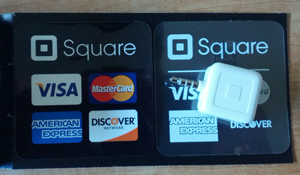
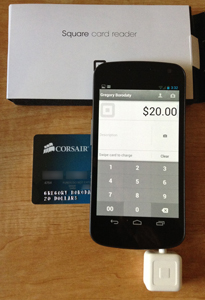 For example, I recently got a $20 rebate check from Corsair for the power supply I purchased for my latest computer. Instead of carrying the card around and finding ways to use it, I loaded up the Register app on my phone, plugged in the dongle, logged into the account, and paid myself the $20. Sure, Square charges a flat card processing fee of 2.75%, so I lost $0.55, but I would have probably lost a lot more than that when the balance got down to a couple of dollars.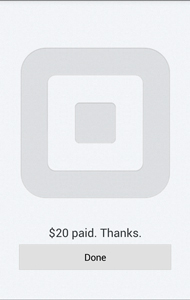
 As a recovering Google Reader addict
 A little over a month ago, the following article appeared in my Google Reader: “
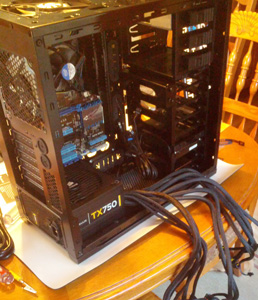
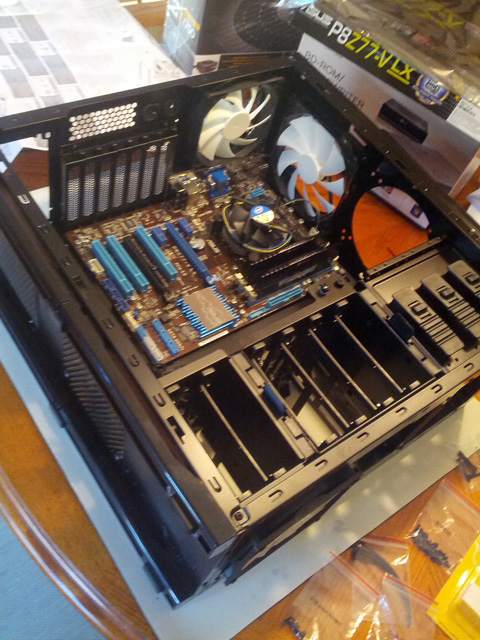 The case is awesome and just looks cool. I really like all the open spots and fans that keep everything running cool, and there’s plenty of space inside to work with when installing components. I also like the idea that the power supply is placed at the bottom of the case, which helps to keep it a bit cooler and keeps the fan noise down.