Category Archives: Must Reads

Book review(s): Daemon and Freedom

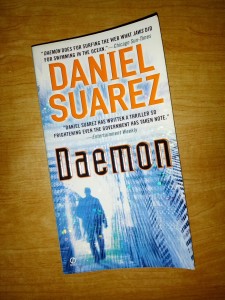
Daemon by Daniel SuarezAfter enjoying the William Hertling books Avogadro Corp and A.I. Apocalypse, I figured it would be a safe bet to try another Brad Feld recommendation and pick up Daemon by Daniel Suarez. I was right.

Daemon is a suspenseful, riveting, action-packed mystery thriller. It starts out with a series of events that occur in the Potrero Valley near Thousand Oaks, CA. Through an investigation of the incidents, it slowly becomes clear that they are related and being coordinated by a dead man, or so it seems. As it turns out, he’s written a computer program, or daemon, which gets initiated by news of his death and whose subsequent actions are triggered through current news events. The program incorporates elements of artificial intelligence to morph itself into something bigger and more encompassing over time, and depending on your point of view, that something can be considered either good or evil for society at large.

The story holds together really well, and kept me engaged for long stretches of time. There were a couple of nights where I was unable to put the book down and stayed up much later than I intended. To top it off, Suarez’s descriptions of the environments are very accurate and realistic. I’m pretty familiar with the Portrero Valley, and and his descriptions made me feel like a part of the story. The problem, I ended up having very vivid dreams about the characters and events of the book. Yes, the story is that engaging, and the characters are very well developed.

Suarez also does a great job of building the book to a crescendo at the end and will leave you wanting to move right onto the sequel, Freedom, which I promptly did, of course.
Freedom by Daniel SuarezFreedom continues the story from Daemon and did not disappoint me. The story moves just as quickly as Daemon, the action scenes were just as intense, and he takes the development of the characters to another level. By the end of the book, you feel a strong connection to all of the main characters in the story. My only disappointment was the climax of Freedom, which surprised me in how predictable it was. The rest of the story was full of so many plot twists that I was surprised Suarez didn’t throw a few more in toward the end of the book. On the other hand, I did find the ending satisfying and appropriate, and that’s all I’ll say so I don’t ruin the book for you.

I would strongly recommend reading both Daemon and Freedom, especially if you enjoy thrilling, action-packed books with strong characters. It’s also a great commentary on technology and how it can be used for both good and evil purposes. Suarez clearly has some opinions and biases that are apparent throughout the book, but they are done in such a way that doesn’t take away from the story.

One last word of caution before you start reading. If you are concerned about the government’s ability to monitor our electronic communication, such as the NSA PRISM program, or tend to be a conspiracy theorist, these books will fuel those thoughts. It gave me a lot to think about regarding how much of what we do is electronic and how easily it can be monitored, controlled, and manipulated. Well worth reading if you’re curious about the technology that governments, law enforcement agencies, big business, and others are using to track us.

Bottom line, Daemon and Freedom are must reads in my opinion.
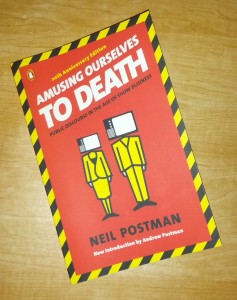
Book Review: Amusing Ourselves To Death

Book - Amusing Ourselves to DeathA few months ago, I picked up the Neil Postman book, Amusing Ourselves to Death: Public Discourse in the Age of Show Business. The book was recommended on a couple of blogs I follow and by a friend, so I figured it was a safe read.

The first thing to note about the book is that it is a nonfiction work discussing how technology is changing the way society functions, and not necessarily in a positive way. The second, and more amazing, thing to note is that the book was written in 1985, nearly 30 years ago. Why is this amazing? The book is just as relevant now as it was in 1985, if not more so.

In his book, Postman explores the effect of technology on society. In a very powerful foreword, he contrasts the predictions of George Orwell’s 1984 and Aldous Huxley’s Brave New World. As he puts it:

Orwell warns that we will be overcome by an externally imposed oppression. But in Huxley’s vision, no Big Brother is required to deprive people of their autonomy, maturity and history. As he saw it, people will come to love their oppression, to adore the technologies that undo their capacities to think.

Postman continues by expounding on Huxley’s fears, that he feared “those who would give us so much that we would be reduced to passivity and egoism” and “the truth would be drowned in a sea of irrelevance.” He wraps up with this powerful statement:

In short, Orwell feared that what we hate will ruin us. Huxley feared that what we love will ruin us.

In essence, the point of Postman’s book is to show that Huxley’s dystopian view of the future has won out over Orwell’s. And while the book starts out a bit dry as he reviews a history of technology evolution and its impact on public discourse, it is a necessary build up to show how the technology of 1985 was enabling Huxley’s view of the future. What is more amazing, he portends how technology will continue to erode society and culture, and when one looks at our infatuation with the internet, social media, smartphones, and other technology diversions, it’s hard to argue Postman’s point that we’re getting closer to living in a Brave New World rather than 1984.

I must admit that at times, I found the book disconcerting as it left me longing for the past. A time where technology wasn’t prevalent. Where news in one’s community mattered more than news on the opposite side of the world. Where politicians were elected on the basis of their views and knowledge, not on their ability to produce 3 second television sound bytes. Where people engaged in deep, meaningful, rich conversations with one another, not in 140 character messages.

However, once I realized that technology is so integrated and woven into the fabric of our society that there is no going back, the power of Postman’s work became apparent. He does a magnificent job describing how the prevalence of technology affects human psychology and interaction. With that knowledge, I began to consider how people are using technology to influence others (including me), how to recognize it, and how to use it. In other words, we shouldn’t fear technology, but rather embrace it, understand its effects, and learn how to use it as a tool rather than letting it use us.

My recommendation, Amusing Ourselves to Death is a must read book. It will open your eyes to how technology has changed society and how it continues to do so, in ways that aren’t necessarily positive. It will make you think, particularly how you interact with all of these amazing inventions, gadgets, and diversions that we’re provided today. It also encouraged me to pick up a copy of Brave New World (which I’ll review later), and it has me interested in picking up Postman’s follow-up book to Amusing Ourselves to Death entitled, Technopoly: The Surrender of Culture to Technology.

Book Review(s): Avogadro Corp and A.I. Apocalypse

Even though I’m not the most prolific reader, I really enjoy it. Especially when you get into a book that you just can’t put down.

I had gotten away from reading regularly the past couple of years with only occasional reading of business books and other non-fiction. Around the middle of last year, I decided it was time to start broadening my horizons and delving into some science fiction based upon some posts I had seen on Brad Feld’s blog. Basically, it dawned on me that reading science fiction might provide an indication of coming technology advancements.

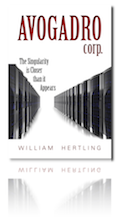
Avogadro CorpFor my first venture into the genre, I picked up Avogadro Corp: The Singularity Is Closer Than It Appears by William Hertling based on a review written by Brad Feld. I wasn’t disappointed.

I’ll admit that the book takes a bit to get going, especially if you have an engineering background. Hertling uses the first part of the book to provide some technical background to the subject of artificial intelligence and how engineering and technical decisions are made in a corporate environment. It helps to make the rest of the book more accessible to non-technical types, and it hits a little too close to home if you have an engineering background, particularly in software.

The second half of the book is a fast-paced action thriller which I had a hard time putting down. In fact, it probably took me the better part of a week to pour through the first half of the book and one evening of reading to finish the second half. I stayed up a little later than normal one night polishing it off.

Some of the technology in the book is a little far-fetched, at least today, but a lot of it sounds and feels very plausible. In fact, it’s almost scary. If you read the book and are interested in how the author feels about his technology “inventions”, check out this post on his blog.

A.I. ApocalypseOnce I finished Avogadro Corp, I had to pick up the follow-on, A.I Apocalypse. A.I Apocalypse gets right to the action and is pretty much non-stop from start to finish. I polished it off quickly in a couple of evening sittings. It’s a sequel to Avogadro Corp and is set about 10 years beyond the conclusion of Avogadro Corp, which is set in near present times. Hertling does a great job introducing a new plotline and characters into A.I. Apocalypse while masterfully weaving in elements and characters from the first book. The other thing I like about A.I. is that it makes bigger leaps in technology prediction that are for the most part very plausible. In fact, after reading it, I could easily visualize how the technology progression could happen and the impact it would have on my current business.

My recommendation, Avogadro Corp and A.I. Apocalypse are must read books. They will open your eyes and provide a good sense of where technology is heading. Sure there are some items that aren’t entirely plausible, but my gut tells me that 80-90% of the technology described in the books will come to fruition within the next 10-15 years, if not sooner.

I’e become a fan of Hertling’s work, and I’m looking forward to the third installment in the series, The Last Firewall.