Tag Archives: Books

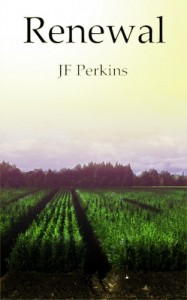
Book review: Renewal

Renewal by JF PerkinsAfter finishing Wool and Shift, Amazon’s recommendation engine (which I love so much) kicked into high gear and suggested Renewal by JF Perkins. Apparently, reading Wool and Shift meant that I had a strong interest in post-apocalyptic fiction. After taking a peek at the mostly positive reviews and dishing out a whole dollar, I dove in.

Renewal is a ten book series that chronicles the plight of a post-nuclear war America, which Perkins refers to as The Breakdown. It’s written from the perspective of a young reclamation engineer and his mentor who live in the Coffee County area of Tennessee. The books build on one another and must be read in order. Each book can be read in one sitting if desired, and the story moves along at a good pace.

Within the book, Perkins maintains two plotlines. One is in the present, focusing on a young reclamation engineer who is befriended by a tribe of people who have formed a self-sufficient society. They operate independently of the surrounding area and government, which is severely under-resourced. Even forty years after The Breakdown, it is stretched too thin to help people rebuild their lives and communities.

The second is a flashback describing the first year after the nuclear holocaust. It’s a story of survival that graphically describes what happens when all of the  infrastructure that we take for granted, such as utilities, food distribution, law enforcement, and more, doesn’t exist. At times, I felt as though I wanted to take notes on the basic survival techniques he describes just in case the worst ever does happen.

I read the entire series over the course of a month and found it entertaining. The overall story and plot held together well, and I liked how Perkins developed the flashback and kept my interest as he tied in characters from the flashback to the present through the latter books.  My only disappointment was the ending. The build-up to a final showdown ended anti-climatically, but I wouldn’t let that stop you from picking it up.

I wouldn’t put Renewal at the top of my “must reads”, but it’s worth a read, especially if you’re a fan of post-apocalyptic fiction and are looking for an entertaining story that can be consumed in bite-size chunks.
Book Review(s): Wool and Shift

Wool by Hugh C. HoweyAfter mowing through Daniel Suarez’s Freedom, I was casually browsing my Kindle for new material when a recommendation for Wool by Hugh Howey popped up. I had recalled an article on Brad Feld’s blog, and since his other recommendations had turned out so well, I figured I’d give it a try. It didn’t hurt that the first book in the series was free, so what did I have to lose other than a little time.

I found myself cruising through the short story in a little over an hour, which is pretty good for me since I’m not the fastest reader in the world. The book was an intriguing character study about a civilization that is relegated to living underground but has a fascination with the outside world that they cannot venture into without paying a substantial price – their life.

At the end of book one, Howey gives you a preview of Book 2 in the series, which gets you hooked into buying it, for the steep price of $0.99. In the second book, Howey paints an even deeper and more vivid picture of the underground environment, the politics of operating the silo (as its called) and the implied class system that has emerged. The imagery, the details, and the characters leave you wanting more, and by the end of Book 2, you’re ready for Book 3, which means you’ll be buying Book 4 and Book 5. At the end of the day, you’re probably best of just getting the Omnibus edition from the outset and saving yourself the angst of whether you’ll continue buying each book in the series, and save a dollar in the process.

Shift by Hugh C. HoweyAfter finishing Wool, you’ll be ready to jump into Shift. Again, it’s a series of short stories, three in total, but I would recommend buying the Omnibus edition again as you’ll find yourself reading all three in no time.

Shift is the prequel to Wool, but make sure you read Wool before Shift, or you’ll miss out on the brilliant story-telling of Howey and the genius with which he brings the story arcs of the two books together.

In addition to the connection between the two series, I also liked how Howey introduces pieces of hard science fiction into the Shift story. It helps to explain a lot of the background and events of Wool, but it’s done in a way that keeps you on the edge of your seat page after page. It’s truly amazing how he is able to connect the two books, and I give him a lot of credit for keeping the events of the two stories in sync. I’m sure they exist, but I’d be hard pressed to find any holes in the stories from the two books.

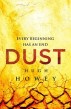
Dust by Hugh C. HoweyWool and Shift are in my must read category. Put together, it’s a great story, it’s very well written, it’s easy to read, and it’s very enjoyable. To top it off, Howey is in the process of releasing Dust, due out this month, which is the conclusion of the Silo story, so I’m sure you can guess what’s up next on my reading list.

Book review(s): Daemon and Freedom

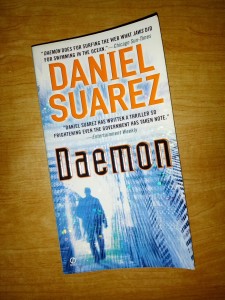
Daemon by Daniel SuarezAfter enjoying the William Hertling books Avogadro Corp and A.I. Apocalypse, I figured it would be a safe bet to try another Brad Feld recommendation and pick up Daemon by Daniel Suarez. I was right.

Daemon is a suspenseful, riveting, action-packed mystery thriller. It starts out with a series of events that occur in the Potrero Valley near Thousand Oaks, CA. Through an investigation of the incidents, it slowly becomes clear that they are related and being coordinated by a dead man, or so it seems. As it turns out, he’s written a computer program, or daemon, which gets initiated by news of his death and whose subsequent actions are triggered through current news events. The program incorporates elements of artificial intelligence to morph itself into something bigger and more encompassing over time, and depending on your point of view, that something can be considered either good or evil for society at large.

The story holds together really well, and kept me engaged for long stretches of time. There were a couple of nights where I was unable to put the book down and stayed up much later than I intended. To top it off, Suarez’s descriptions of the environments are very accurate and realistic. I’m pretty familiar with the Portrero Valley, and and his descriptions made me feel like a part of the story. The problem, I ended up having very vivid dreams about the characters and events of the book. Yes, the story is that engaging, and the characters are very well developed.

Suarez also does a great job of building the book to a crescendo at the end and will leave you wanting to move right onto the sequel, Freedom, which I promptly did, of course.

Freedom by Daniel SuarezFreedom continues the story from Daemon and did not disappoint me. The story moves just as quickly as Daemon, the action scenes were just as intense, and he takes the development of the characters to another level. By the end of the book, you feel a strong connection to all of the main characters in the story. My only disappointment was the climax of Freedom, which surprised me in how predictable it was. The rest of the story was full of so many plot twists that I was surprised Suarez didn’t throw a few more in toward the end of the book. On the other hand, I did find the ending satisfying and appropriate, and that’s all I’ll say so I don’t ruin the book for you.

I would strongly recommend reading both Daemon and Freedom, especially if you enjoy thrilling, action-packed books with strong characters. It’s also a great commentary on technology and how it can be used for both good and evil purposes. Suarez clearly has some opinions and biases that are apparent throughout the book, but they are done in such a way that doesn’t take away from the story.

One last word of caution before you start reading. If you are concerned about the government’s ability to monitor our electronic communication, such as the NSA PRISM program, or tend to be a conspiracy theorist, these books will fuel those thoughts. It gave me a lot to think about regarding how much of what we do is electronic and how easily it can be monitored, controlled, and manipulated. Well worth reading if you’re curious about the technology that governments, law enforcement agencies, big business, and others are using to track us.

Bottom line, Daemon and Freedom are must reads in my opinion.

Book Review: The Forever War

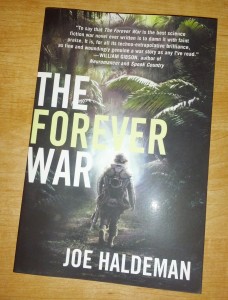
The Forever WarAs part of my dive into the genre of science fiction, a good friend of mine recommended I read The Forever War by Joe Haldeman. I’ll admit that I was a bit skeptical given the book was written almost 40 years ago, but I figured I’d give it a read since it came so highly recommended, and the Amazon reviews were pretty solid, too.

First published in 1974, the story projects a future set in the early 2000’s. The premise of the book is that we’ve started colonizing space, and along the way, we’ve encountered a hostile alien species. From there, Haldeman takes you on an adventure through both space and time. A story that is as entertaining as it is thought provoking since you have to wrap your head around the time dilation that occurs during space travel and its effects on the people who are subjected it. Without spoiling the story, the effects are more mental than physical, and well played out by Haldeman.

Interwoven through the science fiction aspects of the story are a romantic subplot and numerous political and cultural statements about the military, government, society and their interaction. Clearly, these statements are a reflection of the author’s views and his experience as a veteran of the Vietnam War, but they are well done and integrated cleanly into the story and flow of the book. I also like how the story is told from the first person perspective. It really makes the story come alive and makes you feel a part of it.

Overall, I found the book an enjoyable, fun, and fast read. I wouldn’t consider this a must read book, but I would highly recommend it to anyone looking for a little entertainment and diversion this summer.

Book review: The Wide Lens

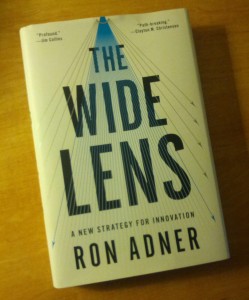
The Wide LensI’m always on the lookout for good business books as a way to expand my knowledge base and management skills. So when a friend suggested I pick up the The Wide Lens by Ron Adner, I figured I’d give it a shot.

With a subtitle of “A New Stategy for Innovation”, it’s pretty clear that the book is about developing winning go to market strategies for products and services. Adner spends a lot of time analyzing both successful and failed new product marketing strategies and uses the lessons learned to develop principles that one can use to create a successful product launch.

Unfortunately, I found the book to be a lot of Monday morning quarterbacking, where the author critiques mistakes and successes of the past to develop a future formula for success. The problem I have with this approach is that hindsight is always 20/20, and using the past to predict future does not always equate to success. So while many of his suggestions are based on solid research, I don’t agree that they can be directly applied to your current products and markets as there are too many variables in play to apply prior strategies to current markets.

I wouldn’t recommend The Wide Lens as a business strategy book. It’s an interesting read on the history of market successes and failures, and that’s what I would suggest you look to get out of it should you decide to pick it up.

Book Review: Amusing Ourselves To Death

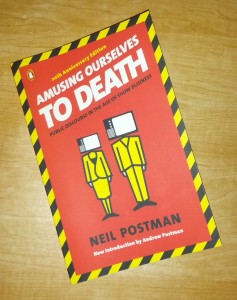
Book - Amusing Ourselves to DeathA few months ago, I picked up the Neil Postman book, Amusing Ourselves to Death: Public Discourse in the Age of Show Business. The book was recommended on a couple of blogs I follow and by a friend, so I figured it was a safe read.

The first thing to note about the book is that it is a nonfiction work discussing how technology is changing the way society functions, and not necessarily in a positive way. The second, and more amazing, thing to note is that the book was written in 1985, nearly 30 years ago. Why is this amazing? The book is just as relevant now as it was in 1985, if not more so.

In his book, Postman explores the effect of technology on society. In a very powerful foreword, he contrasts the predictions of George Orwell’s 1984 and Aldous Huxley’s Brave New World. As he puts it:

Orwell warns that we will be overcome by an externally imposed oppression. But in Huxley’s vision, no Big Brother is required to deprive people of their autonomy, maturity and history. As he saw it, people will come to love their oppression, to adore the technologies that undo their capacities to think.

Postman continues by expounding on Huxley’s fears, that he feared “those who would give us so much that we would be reduced to passivity and egoism” and “the truth would be drowned in a sea of irrelevance.” He wraps up with this powerful statement:

In short, Orwell feared that what we hate will ruin us. Huxley feared that what we love will ruin us.

In essence, the point of Postman’s book is to show that Huxley’s dystopian view of the future has won out over Orwell’s. And while the book starts out a bit dry as he reviews a history of technology evolution and its impact on public discourse, it is a necessary build up to show how the technology of 1985 was enabling Huxley’s view of the future. What is more amazing, he portends how technology will continue to erode society and culture, and when one looks at our infatuation with the internet, social media, smartphones, and other technology diversions, it’s hard to argue Postman’s point that we’re getting closer to living in a Brave New World rather than 1984.

I must admit that at times, I found the book disconcerting as it left me longing for the past. A time where technology wasn’t prevalent. Where news in one’s community mattered more than news on the opposite side of the world. Where politicians were elected on the basis of their views and knowledge, not on their ability to produce 3 second television sound bytes. Where people engaged in deep, meaningful, rich conversations with one another, not in 140 character messages.

However, once I realized that technology is so integrated and woven into the fabric of our society that there is no going back, the power of Postman’s work became apparent. He does a magnificent job describing how the prevalence of technology affects human psychology and interaction. With that knowledge, I began to consider how people are using technology to influence others (including me), how to recognize it, and how to use it. In other words, we shouldn’t fear technology, but rather embrace it, understand its effects, and learn how to use it as a tool rather than letting it use us.

My recommendation, Amusing Ourselves to Death is a must read book. It will open your eyes to how technology has changed society and how it continues to do so, in ways that aren’t necessarily positive. It will make you think, particularly how you interact with all of these amazing inventions, gadgets, and diversions that we’re provided today. It also encouraged me to pick up a copy of Brave New World (which I’ll review later), and it has me interested in picking up Postman’s follow-up book to Amusing Ourselves to Death entitled, Technopoly: The Surrender of Culture to Technology.

Book Review(s): Avogadro Corp and A.I. Apocalypse

Even though I’m not the most prolific reader, I really enjoy it. Especially when you get into a book that you just can’t put down.

I had gotten away from reading regularly the past couple of years with only occasional reading of business books and other non-fiction. Around the middle of last year, I decided it was time to start broadening my horizons and delving into some science fiction based upon some posts I had seen on Brad Feld’s blog. Basically, it dawned on me that reading science fiction might provide an indication of coming technology advancements.

Avogadro CorpFor my first venture into the genre, I picked up Avogadro Corp: The Singularity Is Closer Than It Appears by William Hertling based on a review written by Brad Feld. I wasn’t disappointed.

I’ll admit that the book takes a bit to get going, especially if you have an engineering background. Hertling uses the first part of the book to provide some technical background to the subject of artificial intelligence and how engineering and technical decisions are made in a corporate environment. It helps to make the rest of the book more accessible to non-technical types, and it hits a little too close to home if you have an engineering background, particularly in software.

The second half of the book is a fast-paced action thriller which I had a hard time putting down. In fact, it probably took me the better part of a week to pour through the first half of the book and one evening of reading to finish the second half. I stayed up a little later than normal one night polishing it off.

Some of the technology in the book is a little far-fetched, at least today, but a lot of it sounds and feels very plausible. In fact, it’s almost scary. If you read the book and are interested in how the author feels about his technology “inventions”, check out this post on his blog.

A.I. ApocalypseOnce I finished Avogadro Corp, I had to pick up the follow-on, A.I Apocalypse. A.I Apocalypse gets right to the action and is pretty much non-stop from start to finish. I polished it off quickly in a couple of evening sittings. It’s a sequel to Avogadro Corp and is set about 10 years beyond the conclusion of Avogadro Corp, which is set in near present times. Hertling does a great job introducing a new plotline and characters into A.I. Apocalypse while masterfully weaving in elements and characters from the first book. The other thing I like about A.I. is that it makes bigger leaps in technology prediction that are for the most part very plausible. In fact, after reading it, I could easily visualize how the technology progression could happen and the impact it would have on my current business.

My recommendation, Avogadro Corp and A.I. Apocalypse are must read books. They will open your eyes and provide a good sense of where technology is heading. Sure there are some items that aren’t entirely plausible, but my gut tells me that 80-90% of the technology described in the books will come to fruition within the next 10-15 years, if not sooner.

I’e become a fan of Hertling’s work, and I’m looking forward to the third installment in the series, The Last Firewall.